Understanding
Food Allergy Symptoms and Reactions
Food allergy occurs in 6% of the population less than 5 years of age and in 3.5-4% of the adult population. Food allergies most often start in infants and young children but they can occur at any age. Common food allergens include milk, egg, wheat, soy, peanuts, tree nuts, fish, shellfish, and sesame. Milk, egg, and wheat allergies are often outgrown by around school age.
Symptoms from food allergy usually occur within minutes of ingesting the food allergen, but may be delayed by up to two hours after ingestion. Symptoms include hives, swelling, vomiting, wheezing, cough, difficulty breathing, and a runny nose/sneezing. It is very rare for isolated symptoms in the nose or lungs to occur with a food allergy. Cutaneous symptoms (hives and swelling) are the most common. A less common form of food allergy called food protein-induced enterocolitis syndrome (FPIES) presents with very delayed (up to 4-6 hours after ingestion) vomiting, lethargy, dehydration, and sometimes diarrhea.
Occasionally, there may only be isolated itching of the mouth or throat with the ingestion of raw fruits and/or vegetables, a condition called Oral Allergy Syndrome or Food-Pollen Syndrome. This occurs because the protein structure in certain pollens can be very similar to the protein structure in certain foods.

Food Allergy
Diagnosis
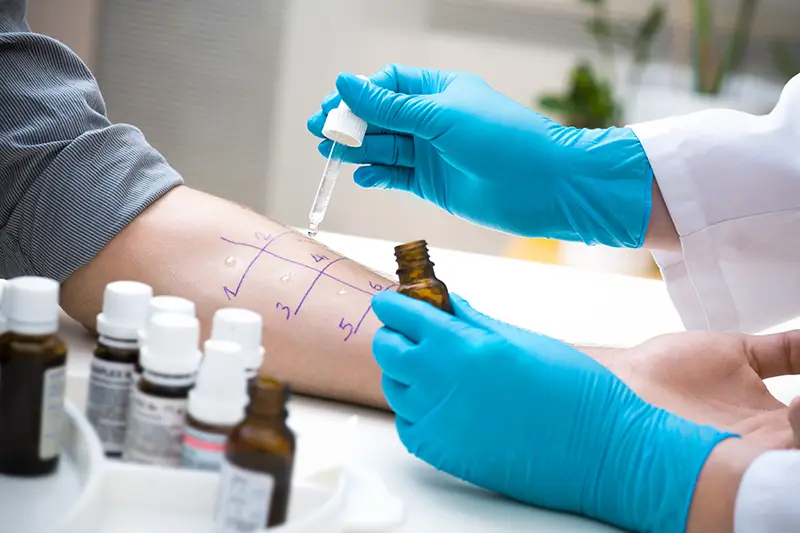
Diagnosing a food allergy requires a careful history, physical exam, food skin testing and/or blood allergy testing, and, in some cases, an oral food challenge. For a food challenge, you will be asked to bring the food into the office so it can be administered starting with a very low dose and then building up over several doses in a controlled, safe environment. Your BVAAC board-certified allergist will take all of these factors into account when diagnosing your food allergy. It is possible to have a positive allergy test to a food and yet not react to the food when eaten. Always speak to your BVAAC board-certified allergist before giving any food that might have the potential to cause an allergic reaction!
Treatment and Prevention
of Food Allergies
There is no cure for food allergies. Some food allergies, such as milk and egg, will probably be outgrown over time. Others, such as peanuts, tree nuts, fish, and shellfish, may persist indefinitely. The treatment options for food allergy have increased in recent years. Whereas strict allergen avoidance was previously the standard of care, and is certainly still a preferred option for some patients and families, oral immunotherapy and Xolair have also emerged as good options on a case-by-case basis. Food allergy/anaphylaxis action plans are created and having epinephrine (either autoinjectors or nasal) available is always recommended in case of reaction. Extensive education in regards to avoidance, label reading, symptom recognition, knowledge of cross-reacting allergens, utilization of epinephrine, etc. is absolutely necessary. Because a positive allergy test does not always mean that there will be symptoms with food ingestion, an in-office food challenge in a safe environment can be very helpful. In fact, 3/4 of children with milk or egg allergy could pass a baked egg/milk challenge in the office. Their future diet could be broadened, and there is evidence that they will outgrow the milk and/or egg allergy faster once the baked form is incorporated into the diet.
There is a tremendous amount of ongoing research in food allergy. A fairly recent study called the LEAP (Learning Early About Peanut) study showed that early peanut introduction can reduce the chances of developing peanut allergy by 80%. A peanut patch and other modalities of immunotherapy are currently being studied as a way to provide protection from peanut allergy. There are several other treatments being studied that are not specific to any one particular food allergen. If and/or when these treatments become FDA approved, they will be available at our clinic.